
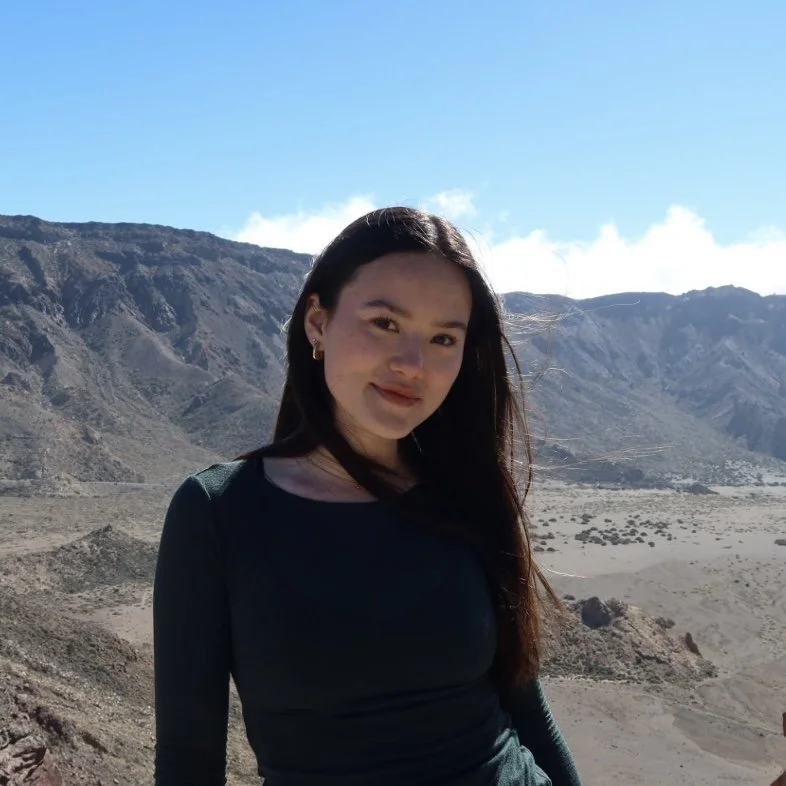
Helena Seibert
I am a German-American who spent my childhood growing up between Europe and USA, and am currently pursuing a Bachelors degree in Economics at Columbia and Sciences Po Paris. I enjoy debating topics at the intersection of politics, geography, history, and development. In particular, I am always curious to meet new people who encourage me to adjust my view of the world. If I am not spending time with friends or family, I likely will be out discovering new cafés or playing tennis.
Sono una ragazza tedesco-americana che ha trascorso l’infanzia tra Europa e Stati Uniti e attualmente sto conseguendo una laurea in Economia presso Columbia e Sciences Po Paris. Mi piace discutere temi all’intersezione tra politica, geografia, storia e sviluppo. In particolare, sono sempre curioso di incontrare nuove persone che mi spingano a rivedere il mio punto di vista sul mondo. Se non passo il tempo con amici o famiglia, probabilmente mi troverete a scoprire nuovi caffè o a giocare a tennis.
Which city has changed you — and why?
The city that immediately comes to mind is San Francisco. To me, San Francisco represents progress, the convergence of diverse cultures, sustainability, and civic engagement. Growing up visiting family there, I had the opportunity to experience the city both from the perspective of a local and a tourist. Upon every visit, I was confronted with new challenges San Francisco was battling - whether traffic gridlock, rising crime and homelessness, or more recently, an abandoned downtown following COVID-19. What struck me was the disconnect between external narratives and local reality. While the press published stories of decline, San Francisco locals were the ones who maintained hope in their city and actively worked to shape its future. Through various tech pilot projects, city-funded community development initiatives, and grassroots engagement programs, I came to admire the locals' refusal to remain passive and live as though their agency had been taken from them. Despite the expansive and sprawling nature of the city, what truly makes San Francisco exceptional is the dedicated people who care deeply about their home and actively invest in the environment they've built. San Francisco taught me that meaningful change doesn't come from accepting circumstances, but rather it comes from individuals refusing to surrender agency, even when problems seem overwhelming.
What kind of city do you dream of for the future?
The city I dream of for the future is one where everyone feels communally connected—where active participation in daily life doesn't lead to the degradation of nature, culture, or infrastructure. It's a place where third spaces bringing people together persist, where individuals act and contribute from intrinsic motivations rather than purely material or altruistic ones. I imagine places where different spheres of life, generations, and interests naturally intersect. Currently, the cities we inhabit reflect values of segregation, exclusivity, and individualism. My dream city would counter this through abundant third spaces, ie. coffee shops, public parks, community centers - constantly pushing me outside my comfort zone and creating opportunities to meet people I wouldn't otherwise encounter. I envision sufficient green spaces where people are encouraged to give back to their communities through a genuine sense of cohesion and belonging, not obligation. I hope for a place where local culture thrives alongside global chains—not rejecting either, but achieving balance between the two. What makes a city alive is the feeling of not being anonymous. Feeling seen and known, even through micro-interactions, such as a regular barista remembering your order, neighbors greeting you by name, all significantly improves quality of life for individuals. This sense of meaning and connection extends beyond one's profession and redirects attention away from the routine we all become trapped in. As to what makes a city fair - to me, a city would be fair when even the least fortunate members of society are well off and able to fully partake in communal life. Fairness isn't solely economic, but more importantly about access, inclusion, and the ability to contribute meaningfully regardless of circumstance.
How will you help transform cities?
I see myself contributing to the transformation of cities by creating and advocating for more third spaces where people naturally converge. As a student, I've come to deeply appreciate multi-purpose cafes, particularly study cafes that transform into trivia night venues, spaces that adapt to different community needs throughout the day. These places are social infrastructures that combat isolation and build casual connections across different demographics. Another urban feature I appreciate is the concept of a 15-minute city. This idea states that essential services, green spaces, and community amenities should be accessible within a short walk or bike ride. This is something I would hope to bring to more cities, though not through top-down planning alone. I have experienced practical interventions to be the most crucial, such as making e-bikes more accessible through subsidized sharing programs, reducing public transport costs to genuinely compete with car ownership, and redesigning streets to prioritize pedestrians and cyclists over vehicles. Beyond infrastructure, I'm drawn to initiatives that activate public space. I envision hosting regular local events, such as monthly food parcours celebrating neighborhood restaurants, pop-up markets featuring local artisans, organized public music performances that don't require tickets or exclusivity. I want to see cities encourage accessible entertainment that simply require showing up.